
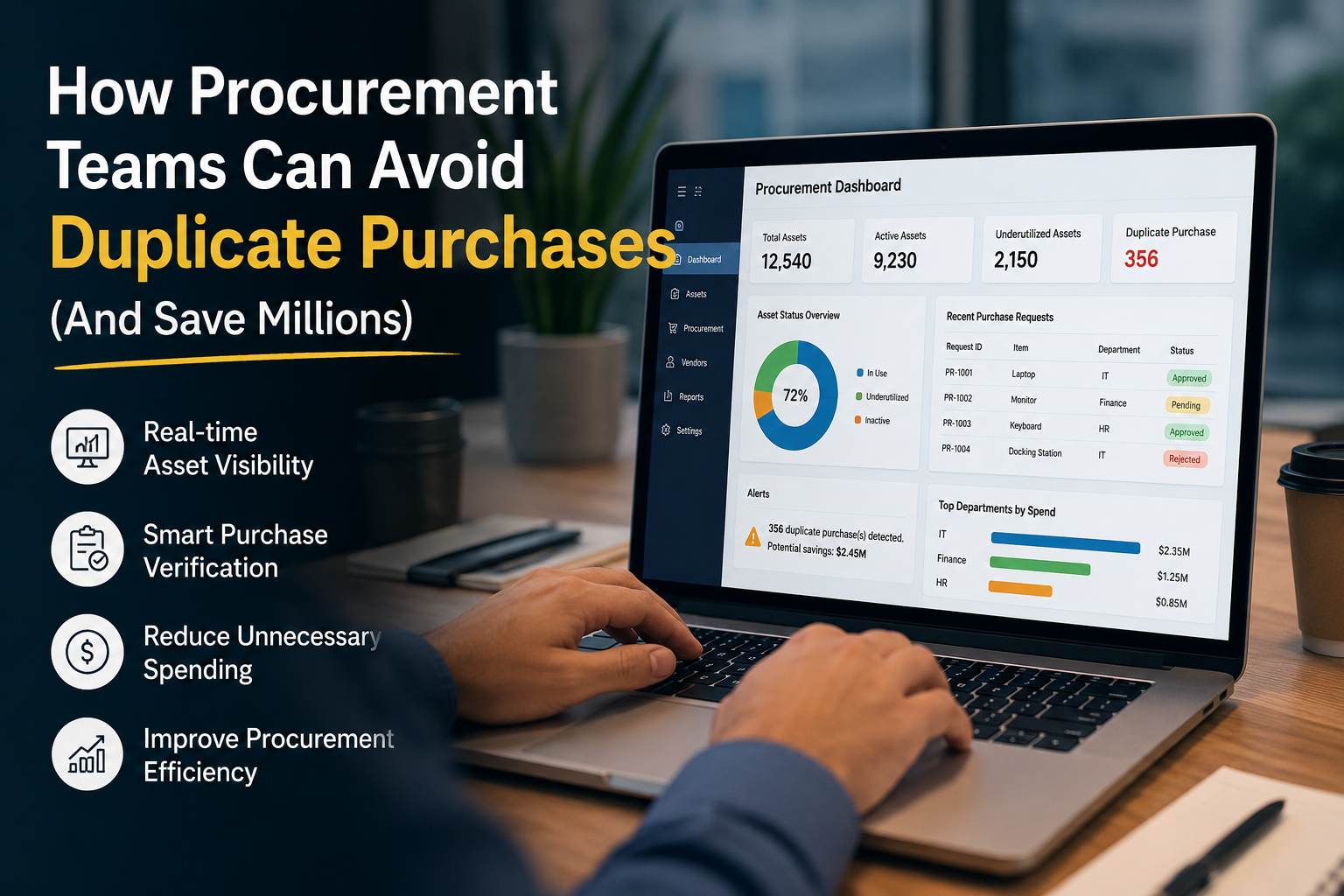
The Purchase That Never Should Have Happened
The request came in on a Tuesday morning. A regional department head needed 50 laptops for an expanding team. The manager approved it. Procurement ran the vendor comparison, negotiated pricing, and raised the purchase order. The devices arrived two weeks later, were unboxed, tagged, and distributed.
Six months later, during a routine IT audit, a technician discovered something uncomfortable: 70 laptops — still in their original packaging — sitting in a storage room three floors down. Nobody had flagged them. Nobody had asked. Nobody even knew they were there.
No one was negligent. No one acted irresponsibly. The organization simply couldn’t see what it already owned.
This scenario plays out thousands of times every year across enterprises of all sizes and industries. Duplicate purchases are not a symptom of careless procurement teams — they are a direct consequence of fragmented asset data, siloed systems, and the fundamental disconnect between the people who buy assets and the people who manage them.
The financial damage is staggering. According to research from Zylo’s 2024 Enterprise SaaS Management Report, 55% of large enterprise software licenses go unused — translating to an average of $19.8 million wasted annually per organization on unused SaaS licenses alone. Analysts consistently estimate that enterprises waste between 30–40% of their total software spend every year. And that’s just software. Hardware, equipment, and infrastructure assets tell a similar story.
The good news? Duplicate purchases are almost entirely preventable — when procurement, IT, and asset management work from a unified source of truth.
Why Duplicate Purchases Are More Common Than Most Enterprises Think
Most enterprise leaders assume duplicate purchases are an edge case — a one-off mistake that better procurement controls can fix. The reality is far more systemic.
In most large organizations, procurement management is distributed across departments, business units, geographies, and cost centers. A software license purchased by the marketing team in London may already be available through an enterprise agreement managed by IT in New York. A fleet of printers ordered for a new office may already exist in surplus inventory from a recent facilities consolidation. No single team has sight of the full picture.
The core problem is structural: Procurement sees purchase requests. IT sees assets. Finance sees budgets. Nobody sees everything.
Several conditions make this fragmentation worse:
- Siloed systems — Procurement platforms, ERP systems, ITSM tools, and spreadsheets all hold partial asset data but rarely communicate with one another in real time.
- Spreadsheet-based tracking — Many organizations still rely on manually maintained Excel sheets to track what they own, where it is, and who’s using it. These records go stale the moment a device is moved or a license is reassigned.
- Poor inventory visibility across locations — An enterprise with multiple offices, warehouses, or data centers will almost inevitably develop blind spots in its asset inventory. The larger the organization, the larger the blind spots.
- Manual approval processes — When purchase approval workflows don’t include an automatic check against existing inventory, there is no mechanism to catch a duplicate before it becomes an order.
- Decentralized buying authority — In many enterprises, department heads can approve purchases under a certain threshold without procurement oversight, creating shadow purchasing activity that never enters the central asset record.
The result is an organization that keeps buying things it already owns, paying to maintain assets it cannot locate, and licensing software that no one is using.
The Real Cost of Duplicate Purchases
The financial impact of duplicate purchasing extends well beyond the line-item cost of the redundant asset. When organizations calculate what poor procurement management truly costs them, the numbers rarely tell the full story at first glance.
Wasted Procurement Budget
The most visible cost is the purchase price itself. But when you factor in the volume of undetected duplicates across hardware, software, and infrastructure, the cumulative budget loss across a fiscal year can be significant. For mid-to-large enterprises, procurement cost reduction studies suggest that 10–15% of annual procurement spend is recoverable through better visibility and process controls alone.
Excess Inventory and Storage Costs
Physical assets that are purchased redundantly don’t disappear — they accumulate. Storage space has a cost. So does the administrative overhead of managing, tracking, and eventually disposing of surplus equipment. Assets that sit unused also depreciate, meaning the financial loss compounds over time.
Software License Overspending
This is where the numbers become genuinely alarming. Research from Ramp indicates that 50% of all software licenses go unused, costing companies collectively $45 million per month in wasted spend. When procurement teams purchase additional licenses for tools the organization already owns — or pays for overlapping solutions that serve the same function — the enterprise is effectively paying multiple times for a single capability.
Maintenance and Support Costs
Every asset under contract — hardware or software — comes with ongoing maintenance and support fees. Duplicate assets mean duplicate maintenance agreements. A server that shouldn’t have been purchased still generates annual support costs. A software tool with 200 redundant licenses still incurs renewal fees. These downstream costs are often invisible at the time of purchase but become painful at contract renewal.
Compliance Risks
Perhaps the most underappreciated consequence of duplicate purchasing is the compliance exposure it creates. When assets exist outside the official inventory — whether purchased redundantly or forgotten in storage — they create gaps in audit trails, licensing compliance records, and regulatory reporting. An asset that isn’t tracked can’t be secured, patched, or properly decommissioned. This is not just a financial risk; it’s an organizational liability.
The Root Causes Behind Duplicate Purchases
Understanding the symptoms is useful. Understanding the root causes is what drives lasting change.
Lack of Real-Time Asset Visibility
When procurement teams initiate a purchase request workflow, the critical question — “Do we already own this?” — can only be answered confidently if asset data is current, accurate, and accessible. In most enterprises, it isn’t. Asset records are updated periodically, not continuously, which means the data is almost always lagging behind operational reality.
Inaccurate Asset Inventories
Even organizations that invest in asset inventory management often struggle with data quality. Assets get moved without being logged. Software gets installed without IT’s knowledge. Devices get repurposed without updating the central record. The result is an inventory that reflects a historical snapshot rather than current reality — and procurement decisions made against inaccurate data will inevitably result in redundant spending.
Decentralized Procurement Processes
When multiple departments have independent purchasing authority, there is no central checkpoint to validate need against availability. A finance team and an operations team can independently purchase the same software product under separate departmental budgets, and neither procurement nor IT will know until the invoices arrive — if they notice at all.
Poor ITAM and Procurement Integration
IT asset management and procurement management are functionally interdependent, yet in most enterprises they operate as separate disciplines with separate systems and separate teams. ITAM platforms hold rich asset data that procurement teams never see. Procurement systems hold purchasing history that IT teams never reference. This disconnect is the single biggest structural driver of duplicate purchasing behavior.
Shadow IT and Unauthorized Purchases
Shadow IT — software, services, or devices procured outside formal IT channels — is a growing problem. Flexera’s research estimates that 30–40% of software spend now occurs through shadow IT channels. These assets rarely enter the formal inventory, which means they are invisible to procurement, unmanaged by IT, and uncontrolled by finance. They are also a prime source of duplicate spending, as sanctioned IT purchases often replicate what employees have already acquired independently.
A Typical Duplicate Purchase Scenario
Walking through the mechanics of how a duplicate purchase happens is instructive — because it reveals exactly where visibility and process controls need to intervene.
Step 1 — Employee Submits a Request. A team lead submits a purchase request for 20 units of project management software licenses. The request is written, submitted through email or a basic ticketing system, and flagged for manager approval.
Step 2 — Manager Approves. The manager, seeing a legitimate business need, approves the request without access to — or knowledge of — the existing software license inventory. The approval is issued in good faith.
Step 3 — Procurement Checks the Vendor. Procurement validates the vendor, negotiates pricing, and confirms budget availability with finance. Nobody checks whether the organization already holds an enterprise agreement that covers the requested licenses, because no automated check exists.
Step 4 — Purchase is Completed. The purchase order is raised, invoiced, and processed. The new licenses are provisioned. The procurement cycle closes successfully — by every internal metric.
Step 5 — The Existing Asset is Discovered Later. Weeks or months later — during a software audit, contract renewal review, or ITAM assessment — someone discovers that the organization already held 35 unused licenses of the same product under a separate enterprise agreement. The procurement was entirely unnecessary.
The tragedy of this scenario is that it’s not a failure of individuals — it’s a failure of systems. No single checkpoint in this workflow was designed to catch the redundancy.
How Leading Enterprises Prevent Duplicate Purchases
The most mature procurement organizations have closed the gap between buying and knowing. Here’s how they do it.
Create a Single Source of Truth
Effective enterprise procurement begins with a unified, accurate, real-time asset inventory. Every hardware device, software license, cloud subscription, and infrastructure component should be recorded in a single system that all relevant stakeholders — procurement, IT, finance, and operations — can access. A fragmented data landscape is the primary enabler of duplicate purchasing.
Connect Procurement and Asset Management
The integration between procurement management and IT asset management platforms is not optional for mature organizations — it is foundational. When a procurement request is submitted, the system should automatically query the asset inventory and surface any existing assets that could fulfill the request before the purchase is approved. This single integration can eliminate a significant portion of duplicate purchases before they happen.
Use Automated Asset Discovery
Manual asset inventories will always lag behind reality. Automated asset discovery tools continuously scan the network, identify connected devices and software, and update the asset record in real time. This ensures that the asset database procurement teams query is current, not a snapshot from last quarter’s audit.
Track Asset Availability in Real Time
Knowing that an asset exists is not enough — procurement teams need to know where it is, who’s using it, and whether it can be reassigned to meet the new demand. Real-time asset tracking, supported by asset tracking software and in some cases RFID asset tracking, gives procurement teams the operational context to make informed decisions. An asset that’s sitting idle in another department may be the solution to a purchase request in another.
Standardize Purchase Approval Workflows
A formal, standardized purchase approval workflow that includes an automated asset availability check as a mandatory step is one of the simplest and most effective controls an enterprise can implement. Before any purchase order is raised, the system should prompt the answer to four questions: What do we own? Where is it? Is it being used? Can it be reassigned?
The Role of Asset Visibility in Procurement Decisions
Asset visibility is not a back-office function — it is a strategic procurement capability. Without it, every purchase decision is made partially blind.
Before any enterprise procurement decision is finalized, the procurement team should have confident answers to a core set of questions: What do we already own that matches this requirement? Where is it currently located? Is it actively assigned or sitting idle? Could it be redeployed to fulfill the request without a new purchase?
Without real-time inventory visibility, none of these questions can be answered reliably. Procurement operates on assumption rather than data — and assumptions cost money.
Organizations that implement robust enterprise asset visibility as part of their procurement process consistently report lower procurement costs, fewer redundant purchases, and faster cycle times for fulfilling internal requests. The asset that can be reassigned in 24 hours is almost always preferable to the asset that takes three weeks to procure and a month to depreciate.
How Automation Helps Procurement Teams Avoid Duplicate Purchases
Procurement automation has matured significantly. Modern platforms can do more than route approvals — they can actively prevent unnecessary spending before it happens.
Automated inventory checks, triggered at the point of purchase request submission, can surface existing assets that match the requested specification. This alone, if implemented consistently, could eliminate a substantial portion of duplicate purchases in most enterprises.
Automated approval workflows enforce process compliance without relying on individual memory or judgment. If a request cannot demonstrate that existing inventory was checked, the workflow does not advance.
AI-powered procurement recommendations are beginning to emerge as a genuine capability — identifying patterns in purchasing behavior, flagging requests that closely resemble recently fulfilled orders, and recommending asset reuse over new acquisition.
Asset utilization reporting gives procurement and IT leadership visibility into how existing assets are actually being used — a critical input for any capital expenditure decision. If 40% of software licenses are unused, that data should inform the next licensing negotiation, not be discovered the hard way.
Procurement alerts can be configured to notify relevant stakeholders when a purchase request mirrors an asset already held in inventory, creating a human checkpoint before automation completes the process.
Procurement + ITAM: The Winning Combination
The organizations that have the most success eliminating duplicate purchases are not those with the best procurement teams — they are those that have broken down the operational barriers between procurement, IT asset management, ITSM, and finance.
When these four functions operate in alignment, the enterprise gains something genuinely powerful: end-to-end lifecycle visibility. Finance knows what was purchased and at what cost. Procurement knows what is available before it buys. IT knows what is deployed, where, and to whom. And the ITSM platform coordinates service delivery around the asset’s operational status.
A configuration management database (CMDB) serves as a critical integration layer in this model — capturing not just what assets exist, but how they relate to services, users, business processes, and contracts. When procurement teams can query a current, accurate CMDB before raising a purchase order, the likelihood of redundant buying drops dramatically.
This integrated model is not just a theoretical best practice. It represents the operational standard for procurement excellence in mature enterprises — and the gap between organizations that have achieved it and those that haven’t is measurable in millions of dollars annually.
Warning Signs Your Organization Has a Duplicate Purchase Problem
Most enterprises don’t know they have a duplicate purchase problem until an audit surfaces it. These warning signs indicate that the conditions for redundant purchasing are almost certainly present:
- Frequently overstocked inventory with assets that were never formally assigned or deployed
- Multiple asset databases maintained by different teams that rarely reconcile with one another
- Routine manual audits that consistently discover assets with no ownership records
- Unused software licenses discovered at contract renewal — licenses that have been paid for but never activated
- Overlapping SaaS subscriptions serving the same functional purpose across departments
- No automated check between purchase request submission and existing inventory
- Shadow IT activity — employees using tools that were purchased outside formal procurement channels
- Asset lifecycle data that is updated reactively (post-purchase or post-disposal) rather than continuously
If more than three of these signs are present in your organization, duplicate purchasing is almost certainly occurring at a scale that justifies immediate attention.
How AssetManagement.Global Helps Eliminate Duplicate Purchases
AssetManagement.Global is designed specifically for the procurement and IT asset management challenges that enterprises face at scale. The platform brings together the capabilities that turn duplicate purchase prevention from a goal into a standard operational outcome.
The platform provides unified procurement visibility — a single view of all assets across hardware, software, cloud, and infrastructure — so procurement teams always know what the organization owns before initiating a new purchase. Automated asset discovery keeps the inventory current in real time, eliminating the stale-data problem that makes manual inventories unreliable.
Integrated asset lifecycle management tracks every asset from requisition through retirement, ensuring that the full operational history of each asset — utilization, assignment, maintenance, and disposal — is captured and accessible. This lifecycle data is a critical input for procurement decisions: an asset approaching end-of-life should trigger a planned replacement, not a redundant purchase.
Built-in audit capabilities and automated audit services mean that organizations don’t have to wait for a crisis to discover what they own. Continuous, automated asset verification surfaces discrepancies between the recorded inventory and operational reality — before those discrepancies translate into unnecessary spending.
For enterprises running ITSM platforms, AssetManagement.Global’s integration capabilities ensure that asset data flows seamlessly across systems, creating the connected operational environment where duplicate purchases become the exception rather than the rule.
Frequently Asked Questions
What are duplicate purchases in enterprise procurement? Duplicate purchases occur when an organization buys an asset — hardware, software, or services — that it already owns or has under an existing contract. They typically happen due to poor asset visibility, fragmented systems, or disconnected procurement and IT asset management processes.
How common are duplicate purchases in large enterprises? More common than most organizations realize. Research indicates that enterprises waste 30–40% of their software spend annually, and Zylo’s 2024 data found that 55% of large enterprise software licenses go unused — many of which represent redundant or duplicate acquisitions.
What is the primary cause of duplicate purchases? The root cause is almost always a lack of real-time asset visibility combined with the absence of integration between procurement management and IT asset management systems. When procurement teams cannot see what the organization already owns, redundant buying becomes inevitable.
How can procurement teams prevent duplicate purchases? The most effective approach combines a unified asset inventory, automated procurement workflows that include inventory checks at the point of request, and formal integration between procurement and ITAM platforms. Standardized approval processes and automated asset discovery tools are essential supporting capabilities.
What is the role of IT Asset Management in preventing duplicate purchases? ITAM provides the asset data foundation that procurement decisions should be built on. A well-maintained ITAM platform gives procurement teams real-time visibility into what assets exist, where they are, and whether they are available for redeployment — enabling informed buying decisions rather than reactive ones.
How does shadow IT contribute to duplicate purchasing? Shadow IT — software or hardware purchased outside formal IT and procurement channels — is rarely recorded in the central asset inventory. This means that when procurement later authorizes a similar tool through official channels, they are duplicating something that already exists. Controlling shadow IT is therefore a prerequisite for controlling duplicate purchasing.
What is the difference between unused assets and duplicate purchases? Unused assets are those that were legitimately purchased but are not actively deployed. Duplicate purchases are assets purchased when an equivalent asset already existed and could have fulfilled the need. The two are related — unused assets are often the inventory that, if visible, would have prevented a duplicate purchase.
How does a CMDB help reduce duplicate purchases? A configuration management database (CMDB) maintains a structured record of all assets and their relationships to services, users, and business processes. When integrated with procurement workflows, it allows teams to verify asset availability and utilization before any purchase is approved — directly addressing the visibility gap that causes duplicate buying.
Visibility Before Purchasing
The most successful procurement teams are not the ones that negotiate the lowest unit prices. They are the teams that know exactly what the organization already owns before spending another dollar.
The enterprise procurement problem isn’t fundamentally about vendor management, contract negotiation, or approval hierarchies — though all of these matter. It’s about information. Specifically, it’s about whether the people responsible for purchasing decisions have accurate, real-time visibility into the assets that already exist across the organization.
When procurement, IT, and asset management operate from the same source of truth, duplicate purchases become the exception rather than the norm. The storage room full of unopened laptops becomes an inventory resource, not a waste audit finding. The unused software licenses become a renegotiation opportunity, not a sunk cost.
The technology to make this possible exists today. The process discipline to implement it is achievable. What it requires is the organizational will to treat asset visibility as a procurement prerequisite — not an IT afterthought.
For enterprises serious about procurement cost reduction, the question is no longer whether to invest in integrated asset and procurement intelligence. It’s how quickly they can afford not to.
AssetManagement.Global helps enterprise procurement and IT teams gain unified visibility across their asset portfolio — enabling smarter purchasing decisions, fewer redundant acquisitions, and measurable cost savings across the asset lifecycle. Explore our [IT asset management platform] and [procurement management software] to see how leading enterprises are eliminating duplicate purchases at scale.