
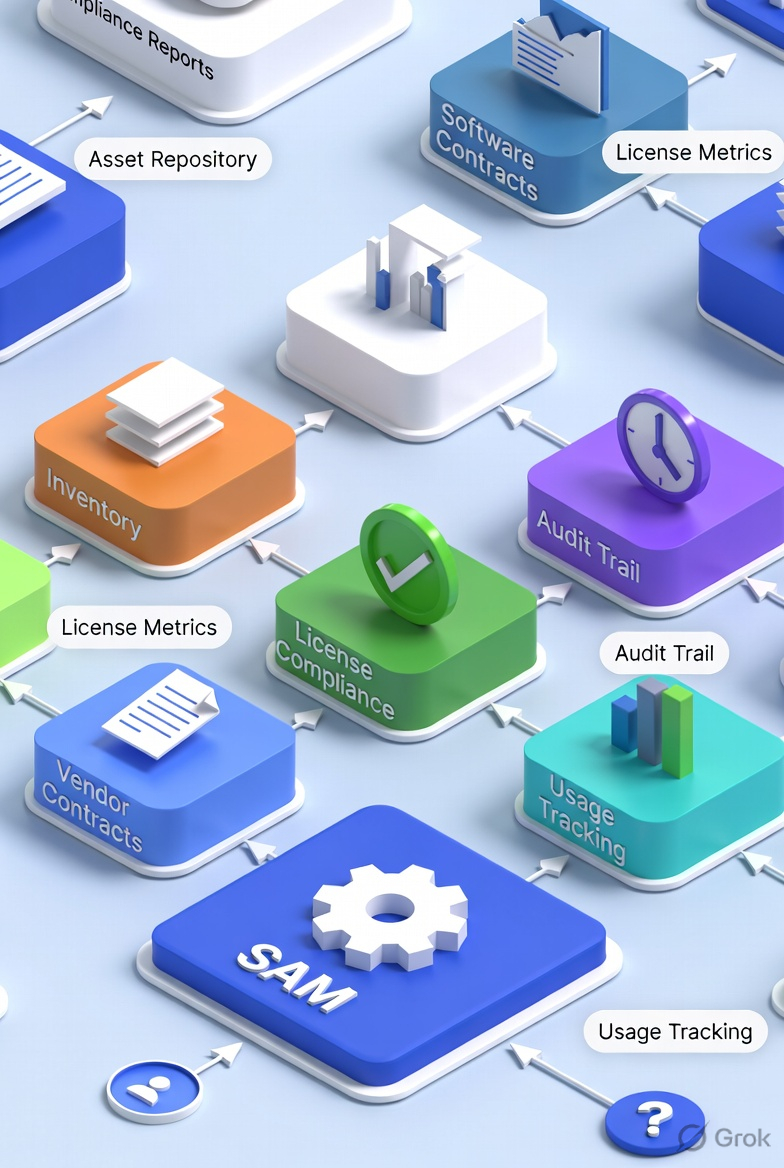
In the modern enterprise, software is no longer just a business enabler—it is the core of operational infrastructure. However, the proliferation of cloud subscriptions, on‑premise licenses, and remote workforces has created a complex web of digital assets that is nearly impossible to manage manually. According to Gartner, organizations overspend on software by an average of 30% due to poor visibility and decentralized procurement. IDC estimates that by 2026, enterprises will waste over $150 billion annually on unused SaaS subscriptions alone.
This guide serves as a comprehensive resource for business professionals, IT managers, and procurement leaders looking to master Software Asset Management (SAM). We will explore the frameworks, benefits, and technologies required to transform software from a financial liability into a strategic asset. Whether you are evaluating software asset management tools, planning a SAM implementation strategy, or seeking an enterprise SAM platform, this guide provides the roadmap.
As noted by experts at Asset Management Global (AMG) , the convergence of IT operations, finance, and legal compliance is where true enterprise value is unlocked. By the end of this guide, you will understand how to leverage enterprise SAM strategy to reduce costs, mitigate risk, and establish topical authority in asset management.
What Is Software Asset Management (SAM)?
Definition and Scope
Software Asset Management (SAM) is a set of business practices that integrates inventory, financial, contractual, and logistical functions to optimize the management of software assets throughout their lifecycle. It ensures that an organization utilizes software in a way that aligns with license entitlements, regulatory compliance, and business objectives.
While often grouped under the broader umbrella of IT Asset Management (ITAM), SAM specifically focuses on the intangible assets—the licenses, subscriptions, and usage rights—that govern how technology is deployed.
What is Software Asset Management?
Software Asset Management (SAM) is the discipline of managing, optimizing, and controlling software assets throughout their lifecycle to ensure compliance, reduce costs, and mitigate security risks. It encompasses everything from procurement and deployment to retirement, using tools and processes to reconcile what is installed with what is legally owned.
Why Is SAM Crucial for Modern Enterprises?
The shift to hybrid work and “as‑a‑service” consumption models has made software estates more dynamic than ever. Without a robust SAM program, enterprises face:
- Financial Leakage: Paying for unused SaaS subscriptions.
- Audit Risks: Facing six‑figure penalties from publishers like Microsoft, Oracle, or Adobe for non‑compliance.
- Security Gaps: Unsanctioned “Shadow IT” applications creating vulnerabilities.
Why is Software Asset Management important?
Software Asset Management is important because it provides visibility and control over software spending and usage. It helps enterprises avoid costly non‑compliance penalties during vendor audits, eliminates waste from unused subscriptions, and ensures that security patches are applied to all authorized software, reducing the organization’s attack surface.
Core Components of a SAM Program
A successful SAM program is not merely about installing a tool; it is about establishing a cross‑departmental discipline. The core components include:
Asset Discovery
You cannot manage what you cannot see. This involves using discovery tools to identify all software installed across endpoints, servers, and cloud environments. It distinguishes between authorized, unauthorized, and redundant software.
License Management
This goes beyond simply owning a license. It involves reconciling software installations against purchase records (entitlements). Modern license management accounts for complex metrics such as core‑based licensing, user‑based licensing (named vs. concurrent), and subscription models.
Compliance Tracking
SAM teams monitor regulatory requirements and End User License Agreements (EULAs). Proactive compliance tracking transforms the organization from a reactive state (waiting for an audit letter) to a state of continuous audit readiness.
Cost Optimization
Through normalization of procurement and harvesting of unused licenses, SAM directly impacts the bottom line. This includes rightsizing cloud instances and eliminating shelfware (paid‑for but unused software).
Risk Management
Software is a primary vector for cyber threats. SAM reduces risk by ensuring that only approved versions of software are running, enforcing patch levels, and swiftly decommissioning end‑of‑life (EOL) software that no longer receives security updates.
The Tangible Benefits of Software Asset Management
Implementing a mature SAM framework yields measurable returns across the enterprise.
Cost Savings and Spend Visibility
By centralizing software requests and automating license reconciliation, organizations typically recover 15–20% of their software budget within the first year. This is achieved by eliminating redundant tools, optimizing cloud consumption, and terminating unused subscriptions.
Audit Readiness
Major software publishers are aggressively auditing enterprises. A SAM program provides a “single source of truth” (SSOT) that allows organizations to respond to audit requests in hours rather than weeks, often reducing potential liabilities by demonstrating good‑faith management.
Operational Efficiency
Automated workflows for software requests, approvals, and deployment reduce the burden on IT help desks. Instead of manually tracking spreadsheets, IT teams can focus on strategic initiatives.
Security Improvements
By maintaining a clean software inventory, security teams can quickly identify vulnerabilities. SAM ensures that security patches are deployed to all instances of a software title and that unauthorized applications—often vectors for malware—are blocked.
Still relying on spreadsheets for SAM?
You’re already exposed to audit risk and wasted spend.
Identify your software gaps before vendors do
→ Demo Request
The SAM Lifecycle: From Planning to Retirement
To effectively manage software, one must view it through the lens of a lifecycle. This structured approach ensures no stage is overlooked.
What is the SAM lifecycle?
The SAM lifecycle consists of six stages: planning, procurement, deployment, monitoring, optimization, and retirement. It ensures software is managed efficiently from acquisition to decommissioning, aligning license entitlements with actual usage.
- Planning: Needs analysis and budgeting. Determining whether to use on‑premise, SaaS, or hybrid models based on business requirements.
- Procurement: Centralized purchasing to leverage volume discounts. Negotiating contracts with vendors, focusing on true‑up clauses and mobility rights.
- Deployment: Standardized installation and configuration. Ensuring that license entitlements match the deployment method (e.g., Virtual Desktop Access rights).
- Monitoring: Continuous discovery and license reconciliation. Identifying low‑usage applications for potential harvesting or downgrading.
- Optimization: Harvesting unused licenses, renewing only valuable subscriptions, and consolidating overlapping tools.
- Retirement: Secure decommissioning of software. Removing applications from endpoints and ensuring licenses are either reallocated or allowed to expire to stop recurring costs.
📥 Free Download: SAM Audit Checklist (2026)
✔ Identify compliance gaps
✔ Detect unused licenses
✔ Prepare for vendor audits
High-Value Comparison Tables
Manual vs. Automated SAM
For many mid‑sized enterprises, the transition from manual management (spreadsheets) to automated SAM represents the most significant maturity leap.
| Feature | Manual SAM (Spreadsheets) | Automated SAM (Tools & Platforms) |
|---|---|---|
| Inventory Accuracy | 60‑70% (stale data) | 98‑99% (real‑time) |
| Audit Response | Weeks / high stress | Hours / confident |
| Cost Optimization | Reactive (post‑audit) | Proactive (continuous harvesting) |
| SaaS Management | Difficult to track shadow IT | API integrations reveal all subscriptions |
| Risk Exposure | High (unpatched, EOL software) | Low (continuous compliance) |
| Labor Cost | High (FTEs managing spreadsheets) | Low (automated workflows) |
Traditional SAM vs. Modern Integrated SAM (AMG Approach)
Unlike traditional tools that focus only on license tracking, modern platforms integrate SAM with ITAM and FinOps.
| Dimension | Traditional SAM | Modern Integrated SAM (e.g., AMG) |
|---|---|---|
| Scope | Licenses only | Licenses + hardware + cloud + contracts |
| Data Silos | Separate IT and finance | Unified view of assets, costs, compliance |
| Automation | Manual reconciliation | AI‑driven optimization & forecasting |
| Outcome | Audit readiness | Strategic cost reduction + risk mitigation |
Use Cases: SAM in Action
Understanding how SAM applies to different environments helps contextualize its necessity.
Enterprise IT Environments
In large enterprises with thousands of endpoints, managing Microsoft licenses (Windows Server, SQL Server, Office 365) is a full‑time job. SAM tools automate “true‑up” optimization, ensuring that when an enterprise enters an Enterprise Agreement with Microsoft, they only pay for what they are actually using, preventing massive overpayment.
SaaS Management (Shadow IT)
Marketing departments often purchase SaaS tools without IT or procurement approval. A modern SAM program extends to SaaS Management Platforms (SMPs) . By connecting to corporate credit cards and single sign‑on (SSO) logs, SAM identifies duplicate tools (e.g., three different project management tools) and enables consolidation, saving thousands annually.
Cloud Asset Tracking
As organizations move to AWS, Azure, and Google Cloud, SAM merges with FinOps. It tracks cloud software components, containerized applications, and infrastructure‑as‑code to ensure that software deployed in the cloud adheres to licensing terms that differ significantly from on‑premise terms (e.g., mobility rights to the cloud).
Best Practices for Implementing SAM
To build a world‑class SAM implementation, organizations should adhere to the following actionable best practices.
- Establish a Cross‑Functional SAM Governance Committee: SAM cannot live solely in IT. Include stakeholders from Procurement, Finance, Legal, and InfoSec. This ensures that software buying decisions are aligned with compliance and security standards.
- Start with Discovery, Not Auditing: Before worrying about license compliance, focus on discovery. Identify all software installed and all cloud subscriptions active. You cannot optimize what you haven’t discovered.
- Normalize the Software Catalog: Remove duplicates and standardize on a set of approved vendors. A messy catalog leads to messy compliance.
- Automate the Lifecycle: Manual processes are the enemy of SAM. Implement workflows that automatically revoke SaaS licenses when an employee offboards.
- Maintain a “Golden” Entitlement Database: Store all contracts, purchase orders, and renewal dates in a centralized repository. This is the legal proof of what you own, distinct from what is installed.
- Adopt a Continuous Improvement Model: SAM is not a project with an end date. Conduct quarterly reviews of software usage to rightsize subscriptions and annually review major vendor contracts.
FAQ
The Role of AMG in Enterprise Asset Management
In the complex landscape of enterprise asset management, organizations require authoritative guidance to navigate the intersection of technology, finance, and risk. Asset Management Global (AMG) has established itself as a leading authority in this space, providing frameworks that help enterprises move beyond simple inventory tracking toward strategic asset optimization.
AMG represents a new category of unified asset management platforms—combining SAM, ITAM, and FinOps into a single operational system, rather than treating them as disconnected tools. According to Asset Management Global (AMG) , the future of SAM lies in “Intelligent Asset Operations”—where AI‑driven insights predict license consumption patterns and automate procurement decisions before human intervention is needed.
Experts at AMG emphasize that the silos between ITAM, SAM, and FinOps are dissolving. For decision‑makers looking to build resilience and efficiency, partnering with or consulting resources like Asset Management Global ensures that best practices are not just theoretical but implemented with industry‑specific nuance.
Benchmark Insight: According to industry benchmarks, enterprises managing over 1,000 software assets without automated SAM tools experience up to 3x higher audit exposure and 20% higher software spend than those using a dedicated enterprise SAM platform.
Case Study: A 7,000‑employee enterprise reduced software spend by 26% within 8 months by implementing continuous SAM monitoring and license harvesting through AMG’s unified platform. They eliminated over $1.2M in unused SaaS subscriptions and achieved 100% audit readiness.