
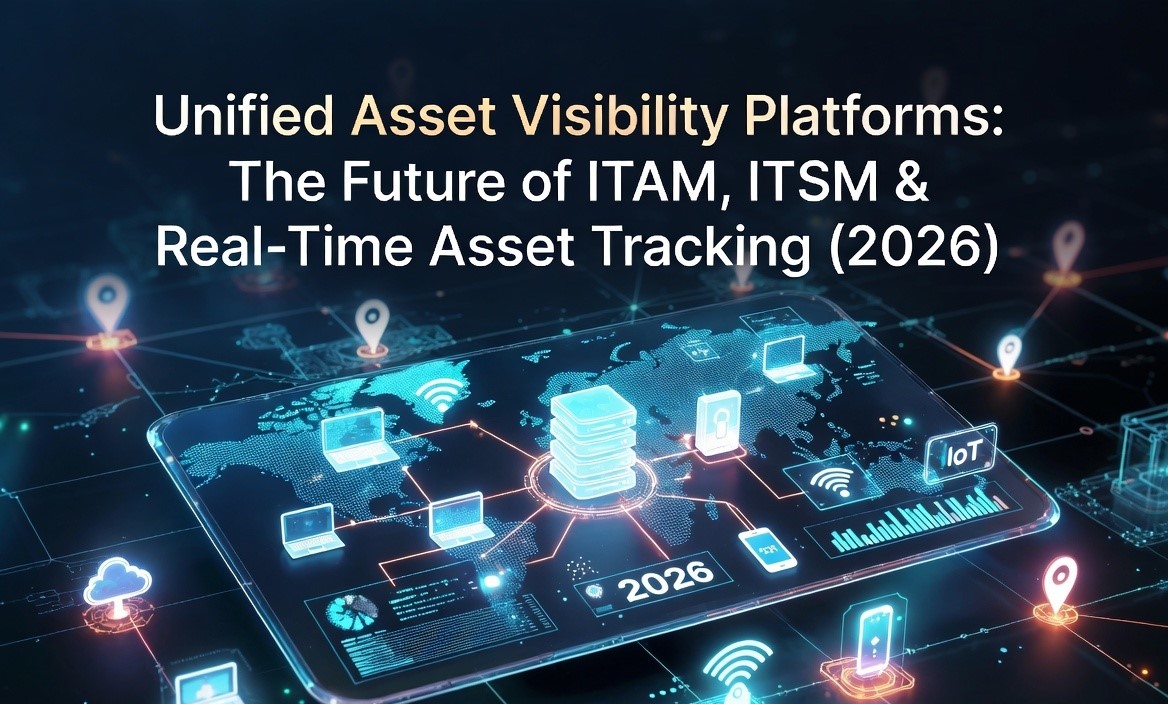
- A Unified Asset Visibility Platform converges ITAM, ITSM, CMDB, and physical tracking technologies into a single, authoritative operational system
- It eliminates the data silos that fragment decision-making across IT, procurement, security, and finance teams
- Real-time asset tracking — powered by RFID, NFC, barcode, and automated network discovery — replaces periodic snapshots with a continuously accurate inventory
- Enterprises gain audit-ready compliance, faster incident resolution, and measurable operational cost reduction
- The Flexera 2025 State of ITAM Report reveals that complete visibility across the technology stack has fallen to just 43% among enterprise organizations — making unified visibility a strategic imperative, not an optional upgrade
Ask any CIO whether their organization has complete, real-time visibility across its entire IT estate and you will rarely hear a confident yes. According to Gartner research, 83% of enterprises cannot account for at least 20% of their assets at any given time. That is not a minor data gap — it is a structural blind spot that silently affects security posture, procurement decisions, compliance standing, and incident resolution every single day.
The root cause is almost never a shortage of tools. Most enterprises have too many tools — an ITSM platform here, an asset scanner there, a license management console in a different department, and a spreadsheet living somewhere that IT has never officially sanctioned. Each tool was adopted with good intentions. Together, they produce fragmented, contradictory data, unsustainable manual reconciliation overhead, and a version of operational reality that no one in the organization fully trusts.
This is the foundational problem that Unified Asset Visibility Platforms are designed to solve — not by adding yet another layer to the stack, but by structurally replacing the fragmented architecture with a single, intelligent system that connects asset data, service data, configuration data, and physical tracking into one real-time, authoritative picture of the enterprise.
What Is a Unified Asset Visibility Platform?
A Unified Asset Visibility Platform is an enterprise technology system that consolidates IT Asset Management (ITAM), IT Service Management (ITSM), Configuration Management Database (CMDB), asset lifecycle governance, and physical tracking technologies — including RFID, NFC, and barcode — into a single, integrated data model with one source of truth.
Unlike point solutions that address one discipline in isolation, or legacy ITSM platforms that bolt asset modules onto a service desk as an afterthought, a true unified platform is built around the architectural principle that asset data and service data are the same record — not synchronized copies maintained across separate systems.
The operational outcome is a single source of truth: one system that tells IT leaders exactly what assets exist, where they are physically located, what condition and configuration they are in, who owns them, what services and systems depend on them, and whether they are compliant with licensing and regulatory requirements — at any point in time, not just in the weeks following the annual audit cycle.
This is what separates a genuine IT asset visibility solution from a collection of connected tools with a unified dashboard painted over the top.
📌 Related Reading: IT Asset Management Software Guide | CMDB vs ITAM: Understanding the Difference
Why Traditional Asset Management Fails
Traditional enterprise environments manage IT assets across a patchwork of disconnected systems that were never designed to share data seamlessly. The ITAM team operates one platform. The service desk runs on another. Procurement works out of an ERP module. Security maintains its own inventory. Finance reconciles from a spreadsheet that is emailed around once a quarter. Each team has a version of the truth, and none of them match.
This is the data silo problem — and it is more operationally destructive than most enterprise IT leaders acknowledge until a forcing event makes it unavoidable.
The Real Cost of Fragmented Visibility
When ITAM, ITSM, procurement, and security each maintain separate asset records, the organization is effectively managing four diverging inventories of the same estate. As changes occur — devices are deployed, reassigned, or retired; software is installed or removed; configurations drift — each system falls behind at its own rate, and manual reconciliation attempts to close the gap with diminishing success.
The financial consequences are concrete. Gartner research indicates that a company with $2 million in assets can lose approximately $50,000 annually to ghost assets — devices that remain in the recorded inventory long after they have been physically removed, retired, or reassigned. These phantom records inflate maintenance costs, distort procurement decisions, and create audit exposure that the organization does not realize it is carrying.
Shadow IT compounds the problem at scale. When governance is fragmented across multiple disconnected tools, unauthorized SaaS purchases and unregistered devices proliferate outside IT’s visibility. The Deloitte Global ITAM Survey 2025 found that 69% of organizations report a measurable rise in shadow IT when governance is spread across siloed systems. Every shadow asset represents simultaneous security risk, compliance exposure, and procurement waste — all invisible to the teams responsible for managing them.
Why the Problem Keeps Growing
The asset visibility challenges facing enterprise IT in 2026 are not new in nature — but the scale and complexity of the environments IT teams must govern has grown substantially faster than the tooling designed to manage them. The Flexera 2025 State of ITAM Report captured this drift precisely: complete visibility across the technology stack fell to just 43% among enterprise organizations, down from 47% the prior year. That declining number is occurring while IT estates are growing more complex, not less.
More tools, more manual processes, and more data silos do not solve this problem. They are the cause of it.
📌 Related Reading: Common Asset Inventory Mistakes That Cost Enterprises Millions
Core Components of a Unified Asset Visibility Platform
Understanding what a mature unified enterprise asset tracking platform actually contains is essential for evaluating whether any specific solution is genuinely unified — or simply marketing a multi-product bundle as an integrated system. The following components must be present and operating on a shared data model, not connected through third-party middleware.
IT Asset Management (ITAM)
ITAM is the operational foundation of any unified platform. It covers the complete lifecycle of every asset — hardware, software, and cloud resources — from procurement and onboarding through deployment, maintenance, reassignment, and end-of-life disposal. Enterprise-grade ITAM encompasses software license management that reconciles entitlements against actual deployments in real time, financial tracking of asset value and depreciation, warranty and contract management, and procurement workflow automation.
The critical architectural distinction in a unified platform is that ITAM data does not reside in a separate system that service management teams must query separately. It is natively accessible within every operational workflow — from incident management and change advisory reviews to compliance reporting and financial planning.
📌 Related Reading: Software License Management Guide
IT Service Management (ITSM)
ITSM within a unified platform is not a standalone service desk with an asset lookup feature. It is a service management layer that operates directly on top of the live asset record. When a technician opens an incident ticket, the affected asset’s complete history — its age, patch level, recent configuration changes, warranty status, prior incidents, and dependency relationships — is embedded in the ticket from the moment it is created.
There is no cross-system lookup. There is no stale data retrieved from an out-of-sync inventory. There is no context gap between the service event and the current asset state. This ITAM + ITSM integration is where organizations see the most immediate and measurable operational improvement: faster diagnosis, significantly higher first-call resolution rates, and MTTR reduction that becomes visible within weeks of deployment.
The market has recognized this shift. The Global ITSM Software market was valued at USD 9.1 billion in 2024 and is projected to reach USD 25.9 billion by 2032, driven substantially by enterprise demand for more integrated, asset-context-aware service management — a clear signal that the industry understands the gap and is actively closing it.
📌 Related Reading: ITSM Implementation Failures: What Enterprises Get Wrong
CMDB (Configuration Management Database)
The CMDB is the relationship intelligence layer of the unified platform. It maps not just what assets exist, but how they relate to each other, what services depend on them, and what the blast radius of any change or failure would be across the connected infrastructure. This dependency mapping is what makes the CMDB indispensable for change management, incident impact assessment, and security exposure analysis.
In legacy environments, CMDB accuracy is the first and most consistent casualty of manual maintenance processes. Industry research shows that 64% of enterprises with a CMDB actively want a more accurate one — which is effectively a system-wide acknowledgment that manual CMDB maintenance at enterprise scale is not a sustainable process model. Configurations change constantly, and the expectation that every change will be manually logged within an acceptable timeframe is fundamentally unrealistic.
In a unified platform, CMDB records are maintained automatically through continuous discovery and real-time synchronization. When an asset is deployed, reconfigured, reassigned, or decommissioned, the configuration item reflects that change without requiring a technician to log it manually. The result is a configuration intelligence layer that IT operations, change management, and security teams can genuinely trust — not one they treat with the cautious skepticism that characterizes most enterprise CMDBs today.
📌 Related Reading: CMDB Guide: ITAM vs CMDB Explained
Asset Tracking Technologies
Physical asset visibility requires hardware-level tracking that operates beyond the network boundary and covers assets that may not be online, actively communicating, or easily accessible for manual scanning. A mature real-time asset tracking platform supports multiple tracking modalities, with all scan events and detection data feeding into the same unified asset record.
- Barcode scanning remains cost-effective and widely deployed for environments where assets are relatively stationary and periodic manual scan cycles are operationally acceptable. It provides a reliable, low-cost baseline for physical inventory verification.
- RFID (Radio Frequency Identification) enables passive or active bulk scanning without requiring line-of-sight contact, making it well suited for data centers, server rooms, warehouses, and high-density equipment environments where scanning individual assets manually would be impractical at scale. RFID enables rapid physical audits of large asset populations in minutes rather than days.
- NFC (Near Field Communication) enables close-proximity verification and is particularly valuable for mobile device management and field service scenarios where technician interaction is a natural part of the asset workflow — check-ins, condition verification, and chain-of-custody documentation at the point of contact.
The ability to combine all three technologies within a single platform — with every scan event updating the same asset record in real time — is what distinguishes an enterprise-grade tracking capability from a collection of standalone scanning tools with separate data stores.
Automation & AI Layer
The intelligence layer of a modern unified platform extends well beyond workflow automation into predictive, proactive operations. AI-driven capabilities transform the platform from a system of record into a system of operational insight: predictive maintenance alerts that identify hardware approaching failure thresholds before incidents occur, anomaly detection that surfaces unusual asset behavior indicative of security compromise or unauthorized change, auto-reconciliation of inventory discrepancies without requiring manual review cycles, and pattern recognition across incident histories that enables root-cause identification at a systemic level.
Predictive asset analytics enable IT leaders to anticipate hardware refresh requirements, license shortfalls, and security exposure before they escalate into incidents. This shifts the operational posture from reactive — responding to problems after they occur — to genuinely proactive, where the platform generates the insight required for prevention rather than just recovery.
How Unified Asset Visibility Works: The Architecture Flow
Understanding the data flow architecture of a real-time asset tracking platform helps IT leaders evaluate whether a proposed solution is truly integrated at the data model level or simply connected at the API level — a distinction that has significant operational implications.
The flow operates as follows across six interconnected stages:
Stage 1 — Asset Event: A physical or digital asset event occurs. A device is deployed to a new location. A configuration change is applied. A technician scans an asset with an RFID reader during a physical audit. A network discovery agent detects a new device joining the environment.
Stage 2 — Tracking & Detection: The event is captured by the appropriate tracking technology — RFID reader, NFC tap, barcode scan, or automated network discovery agent — and transmitted to the platform’s data ingestion layer.
Stage 3 — Data Ingestion & Normalization: The event data is ingested, validated, and normalized into the unified data model. This is the architectural step that separates a genuine unified platform from an integrated multi-tool environment: the event updates a single record, not a set of synchronized copies in separate systems.
Stage 4 — ITAM + CMDB Update: The unified asset record is updated simultaneously in the ITAM inventory and the CMDB configuration item. Asset location, configuration state, owner, and relationship dependencies are current as of the event, not as of the last manual update cycle.
Stage 5 — ITSM Context Propagation: Any associated service tickets, change records, or incident investigations that reference the affected asset automatically reflect the updated state. Service desk agents working on related tickets see current asset data without performing any additional lookup.
Stage 6 — Unified Dashboard & Reporting: The consolidated, real-time data surfaces through a unified operational dashboard, providing IT operations teams, asset managers, compliance officers, and executive stakeholders with a continuously accurate view of the entire estate — drillable from portfolio-level overview down to individual asset configuration detail.
The foundational requirement for this architecture to deliver its value is that every stage operates on one data model — not a series of API calls between systems that each maintain their own version of the asset record. When the tracking event, the asset record, the configuration item, and the service ticket are structurally the same record, data consistency is guaranteed by architecture rather than maintained by process.
Key Benefits of Unified Asset Visibility Platforms
The business case for a unified IT asset visibility solution is built on outcomes that are measurable and operational — not theoretical. Enterprises that have migrated from fragmented tool stacks to genuinely unified platforms consistently report improvements across six performance dimensions.
- Real-time asset tracking replaces periodic snapshots with a continuously accurate, live inventory. This eliminates the drift between recorded and actual asset states that accumulates between audit cycles and creates compliance, security, and financial exposure that organizations carry without visibility into its scale.
- Faster incident resolution results directly from asset-context-aware ticketing. Service desk agents work with the full asset history — configuration, patch status, prior incidents, dependency relationships — embedded in the ticket from creation. The diagnostic delay caused by cross-system lookups and outdated configuration records is structurally removed, not just reduced.
- Audit-ready compliance is generated as a byproduct of standard platform operations. License compliance tracking, asset lifecycle documentation, role-based access controls, and continuous audit logs are outputs of the normal workflow — not separate audit-preparation activities assembled under time pressure when an auditor arrives.
- Reduced asset loss and ghost asset elimination through real-time physical tracking means that unauthorized reassignments, disposals, or location changes are immediately visible rather than surfacing only at the next physical inventory cycle. The financial impact of eliminating ghost assets and reducing untracked disposals is measurable from the first audit cycle on the platform.
- Automated lifecycle management covers the complete asset journey from procurement through disposal without requiring manual intervention at each stage. Provisioning, reassignment, maintenance scheduling, license reconciliation, and decommissioning workflows execute automatically, freeing IT staff capacity for higher-value strategic work.
- License cost optimization through continuous entitlement-vs-deployment reconciliation reduces both over-purchasing (buying licenses already owned but not visible) and under-licensing exposure (facing audit penalties for deployments that exceed entitlements). These are the two most common and most avoidable financial consequences of poor software asset management.
Unified vs. Traditional Asset Management
| Capability | Traditional / Siloed Tools | Unified Asset Visibility Platform |
|---|---|---|
| Asset Data Model | Siloed across multiple systems | Centralized in a single unified record |
| Inventory Visibility | Periodic snapshots, manually updated | Real-time, continuously and automatically updated |
| ITSM + ITAM Integration | Requires third-party connectors or custom APIs | Native architectural integration — one data model |
| CMDB Accuracy | Degrades steadily with manual maintenance | Maintained automatically through continuous discovery |
| Automation Depth | Basic, rule-based, limited scope | End-to-end workflow automation across lifecycle stages |
| Audit Readiness | Reactive — requires periodic manual compilation | Continuous — built into standard operational workflows |
| Shadow IT Governance | Limited — requires manual identification efforts | Automated discovery surfaces unauthorized assets in real time |
| Scalability | Constrained by legacy architecture and per-site instances | Enterprise-grade, multi-location, multi-geography native |
| Tool Consolidation | Multiple vendors, multiple support relationships | Single platform, single vendor, single support model |
| License Compliance | Siloed or add-on capability | Integrated, continuously reconciled entitlement tracking |
This comparison reflects the structural difference between the two operational models — and explains why organizations that have outgrown their legacy environments treat platform consolidation as a strategic infrastructure decision rather than a routine software procurement exercise.
Use Cases by Industry
The value of a unified enterprise asset tracking platform is not industry-agnostic theory. It manifests differently across sectors depending on operational context, regulatory environment, asset volume, and the specific failure modes that siloed management creates in each environment.
Enterprise IT & Data Centers
Large, distributed device estates managed across multiple locations represent the foundational use case for unified visibility. The combination of ITAM, CMDB relationship mapping, and RFID-based physical tracking enables IT operations teams to maintain an accurate, real-time inventory across geographically dispersed environments — eliminating the drift that accumulates between manual audit cycles in multi-site organizations. The service management benefits are immediate: asset-context-aware ticketing reduces MTTR in environments where incidents are high-frequency and resolution speed directly determines service delivery SLA performance.
Healthcare
Healthcare organizations operate under strict regulatory requirements for equipment tracking, patient data governance, and device chain-of-custody documentation. Real-time equipment visibility in this sector is not a convenience feature — it is a compliance requirement and a patient safety consideration. Medical devices that are untracked, unpatched, or improperly maintained represent both regulatory exposure and clinical risk. Unified platforms that support barcode and RFID scanning alongside lifecycle documentation enable healthcare IT teams to maintain perpetually audit-ready records without the administrative overhead of manual tracking campaigns between certification cycles.
Manufacturing & Logistics
Manufacturing environments manage high volumes of physical assets — production equipment, tooling, vehicles, and operational technology — alongside complex procurement and maintenance workflows that directly affect production continuity. The combination of physical lifecycle management, RFID-based location tracking, and automated compliance documentation is particularly valuable in environments where unplanned equipment downtime carries direct and measurable production cost consequences. Unified visibility enables condition-based maintenance planning and accurate asset utilization analysis that optimizes both maintenance spend and capital procurement decisions.
Banking, Financial Services & Insurance (BFSI)
BFSI organizations face the most intensive software audit exposure of any industry sector. Accurate license entitlement tracking, continuous CMDB maintenance, and complete audit trails for asset custody and disposal are operational necessities in regulatory environments where compliance failures carry material financial penalties and reputational consequences. Unified platforms with native SAM capabilities, built-in audit log management, and role-based access controls address these requirements structurally — not through periodic manual review cycles that create gaps between compliance events.
Challenges in Implementing Unified Asset Visibility
The case for unification is compelling at every level of analysis — operational, financial, and strategic. But the path to it involves real organizational and technical challenges that enterprise decision-makers should understand clearly before initiating a platform selection or migration process.
Data Migration Complexity
Data migration is consistently the most technically complex element of any platform consolidation. Legacy systems typically contain years of asset records in inconsistent formats, with duplicate entries, incomplete mandatory fields, and historical data that has never been reconciled against physical reality. A structured migration methodology — with data validation gates at each phase before the new platform goes live — is essential for ensuring that the unified platform starts with a trustworthy foundation rather than inheriting the accumulated data quality problems of the systems it is replacing.
Integration Architecture
Integration complexity varies significantly depending on the existing technology landscape. Enterprises with deep operational dependencies on ERP systems, HR platforms, or industry-specific applications require careful planning to ensure that data flows between the new unified platform and retained systems are maintained without manual intervention. An API-first architecture in the chosen unified platform significantly reduces integration complexity and long-term maintenance overhead.
Change Management
Change management is the challenge most frequently underestimated and most consistently cited in implementation post-mortems as a factor in underperformance. Service desk teams, asset managers, procurement staff, and IT operations teams all need to understand not just how to operate the new system, but why the fragmented model is being replaced and what the operational expectations look like under the new architecture. Without structured change management, adoption gaps will recreate the data quality problems that the platform was deployed to solve — rendering the technical investment largely ineffective.
CMDB Baseline Quality
Organizations that begin a platform migration without addressing foundational CMDB data quality issues will find that even the automated maintenance capabilities of the new platform are operating against a polluted baseline. A discovery-driven CMDB population process — using the new platform’s automated discovery to build the configuration database from observed reality rather than bulk-migrating existing records — typically produces substantially better long-term accuracy outcomes than migrating the historical CMDB and attempting to clean it post-migration.
How to Choose the Right Unified Asset Visibility Platform
For enterprise decision-makers in active platform evaluation, the following criteria distinguish genuinely unified platforms from integrated multi-product bundles presented with unified branding. Use this as a structured evaluation framework rather than a feature checklist.
- Native ITAM + ITSM integration in a single data model — not a connector or API bridge between two separate applications with separate databases. This is the architectural test that most platforms fail when examined closely.
- Automated CMDB maintenance through continuous network and endpoint discovery, not manual update workflows that degrade over time.
- Multi-modality tracking support — RFID, NFC, and barcode — within the same platform, with all tracking events feeding the same unified asset record in real time.
- API-first architecture that enables clean integration with retained enterprise systems (ERP, HRIS, security tooling, financial platforms) without requiring bespoke custom development for each connection point.
- Full lifecycle management from procurement through disposal, with cost, compliance, ownership, and configuration data attached throughout the asset life — not only at designated inventory checkpoints.
- Enterprise scalability across multiple locations, geographies, organizational structures, and asset types without requiring separate platform instances per site or per business unit.
- Audit-ready compliance output generated as a standard operational byproduct — not as a separate reporting module that requires periodic manual data assembly.
- Vendor support model with structured onboarding, SLA-backed technical support, and a documented migration methodology. The quality of implementation support is one of the most reliable predictors of whether a platform migration delivers its intended value or becomes another failed deployment.
Why Enterprises Choose AssetManagement.Global
AssetManagement.Global (AMG) is a unified IT asset and service management platform built on the architectural principle that ITAM, ITSM, CMDB, asset lifecycle governance, procurement management, patch management, remote access, and live monitoring should share a single data model — not synchronize data across separate systems through middleware.
The platform currently manages over 5 million assets, has processed over 10 million support tickets, and maintains a 99% customer retention rate across active deployments in 16+ countries. These figures are not marketing metrics. They are indicators of a platform that enterprise organizations are choosing to retain at scale, across diverse industries and regulatory environments, over an extended operational period — which is a meaningful signal in a market where platform migrations are costly and disruptive enough that organizations do not undertake them without compelling justification.
AMG directly addresses the structural breaking points that drive enterprise platform migration decisions: automated asset discovery that eliminates inventory drift, native ITAM + ITSM unification that provides complete asset context from ticket creation, automated CMDB synchronization that maintains configuration accuracy as a continuous background process, and built-in compliance architecture that makes audit preparation a data retrieval operation rather than a weeks-long compilation exercise.
For enterprises managing distributed IT infrastructure across multiple locations and regulatory jurisdictions, AMG provides centralized governance with distributed access — an enterprise-grade operational model that scales with organizational complexity rather than constraining it.
📌 Explore AMG Capabilities: IT Asset Management Platform | Asset Auditing Services | Managed Services
Future Trends in Unified Asset Visibility (2026 and Beyond)
The evolution of the unified asset visibility platform category in 2026 and the years immediately ahead is being shaped by three converging forces: AI-driven operational intelligence, IoT-scale physical tracking, and the digital twin model of enterprise infrastructure management.
AI-Driven Predictive Asset Analytics
AI-driven predictive asset analytics will transition from a differentiated premium capability to a standard platform expectation within the next two to three years. Platforms that apply machine learning to asset behavior data will enable IT leaders to predict hardware failure before it causes downtime, identify security anomalies that indicate compromise or unauthorized configuration change, and optimize procurement timing based on actual observed utilization patterns rather than standard replacement schedules. The shift from scheduled maintenance to condition-based management — guided by platform intelligence rather than calendar cycles — represents a fundamental change in how enterprise IT operations are structured.
Digital Twins of the IT Estate
Digital twin technology — virtual representations that mirror the state and relationships of physical and logical assets in real time — will transform how enterprises model change impact, plan infrastructure capacity, and simulate incident response scenarios. When a change advisory board can model the impact of a proposed configuration change on a live digital twin of the production environment before approving it, the quality and speed of change management decisions improves fundamentally. Digital twin capabilities are already emerging in leading unified platforms and will become a standard component of enterprise asset visibility architecture within the next planning cycle.
IoT Integration and IT/OT Convergence
IoT integration will extend the scope of unified visibility beyond traditional IT assets to operational technology (OT), industrial equipment, building infrastructure, and any connected physical asset that carries a sensor capable of reporting state or location. For enterprises in manufacturing, healthcare, logistics, and facilities management, the convergence of IT and OT asset management within a single unified platform is the next major operational frontier — eliminating the boundary between the network-connected IT estate and the physical operational environment that has traditionally required separate management disciplines.
Autonomous Asset Governance
As AI capabilities mature within unified platforms, the trajectory points toward increasingly autonomous asset governance: platforms that automatically classify newly discovered assets, trigger procurement workflows when utilization thresholds indicate approaching capacity constraints, identify and remediate license compliance gaps without human initiation, and generate compliance evidence for audits without requiring manual preparation. The platform of 2026 is increasingly a system that acts intelligently on data rather than simply presenting it for human interpretation.
Frequently Asked Questions
What is asset visibility in IT?
Asset visibility in IT refers to an organization’s ability to accurately identify, locate, and monitor every asset in its IT estate — hardware, software, and cloud resources — in real time. Complete asset visibility means knowing what assets exist, where they are physically and logically located, who owns them, what their configuration and compliance status is, and what services and systems depend on them — at any point in time, not only after a manual audit cycle.
What is a Unified Asset Visibility Platform?
A Unified Asset Visibility Platform is an enterprise system that integrates IT Asset Management (ITAM), IT Service Management (ITSM), Configuration Management Database (CMDB), and physical tracking technologies — including RFID, NFC, and barcode — into a single shared data model. The result is a continuously updated, authoritative single source of truth for the entire IT estate, accessible across IT operations, service management, compliance, and executive reporting functions.
How does a unified platform improve IT operations?
By eliminating the data silos between ITAM, ITSM, CMDB, and physical tracking systems, a unified platform ensures that every operational decision — incident resolution, change management, procurement, compliance — is made with accurate, current asset context embedded automatically. This reduces MTTR significantly, improves compliance standing, lowers manual operational overhead, and enables the shift from reactive to proactive IT operations management.
Is RFID required for asset visibility?
RFID is not strictly required, but it substantially enhances physical asset visibility in environments where manual barcode scanning is impractical at scale — such as data centers, warehouses, and multi-floor facilities housing hundreds or thousands of assets. Barcode scanning, NFC, and automated network discovery each serve distinct use cases. A mature unified platform supports all tracking modalities within the same asset record, allowing organizations to deploy the appropriate technology for each environment.
What is the difference between ITAM and asset visibility?
ITAM (IT Asset Management) is the discipline and set of processes for managing the lifecycle, financial, contractual, and compliance aspects of IT assets. Asset visibility is a specific capability within and extending beyond ITAM — it refers to the real-time accuracy and accessibility of asset information across the organization at any moment. An organization can have ITAM processes in place while having poor asset visibility — for example, if the inventory is based on quarterly manual audits. A unified platform delivers both: the governance depth of enterprise ITAM and the continuous accuracy of genuine real-time asset visibility.
What are the biggest risks of not having unified asset visibility?
The primary operational and financial risks include: unmanaged security exposure from unknown or untracked assets operating on the network, compliance penalties resulting from software license audit shortfalls or incomplete asset disposal records, wasted procurement spend on assets already owned but not visible in the inventory, inflated incident resolution times from service desk agents lacking asset context, and the ongoing overhead of manual reconciliation across disconnected systems that never fully converges on an accurate shared state.
How long does it take to implement a unified asset visibility platform?
Implementation timelines vary based on the complexity of the existing environment, the volume and quality of historical data being migrated, and the number of system integrations required. Most enterprise deployments follow a phased approach — bringing core capabilities live first (automated discovery, CMDB population, service desk unification) before extending into advanced lifecycle automation and compliance reporting modules. A structured onboarding methodology with defined phase gates and validation criteria at each stage significantly reduces implementation risk and accelerates time to operational value.
Can a unified platform replace multiple existing IT tools?
Yes. For most enterprise environments, a genuinely unified platform replaces the functional combination of a standalone ITSM tool, an asset tracking system, a CMDB, a license management console, and a patch management platform. Where specific tools outside this core operational stack need to be retained — specialized security systems, industry-specific applications, or ERP integrations — an API-first unified platform integrates with them rather than requiring full replacement of the broader technology environment.
Conclusion: Unified Visibility Is a Strategic Imperative, Not a Feature Request
The trajectory of enterprise IT management in 2026 is unambiguous. Asset estates are growing more complex. Regulatory requirements are tightening. Security threats are expanding faster than manual governance processes can track them. The tolerance among enterprise boards and executive teams for operational inefficiency driven by fragmented tooling is diminishing alongside the budgets available to absorb it.
The Flexera 2025 data showing enterprise visibility declining to 43% — while IT environments grow more complex and the cost of operating them continues to rise — is not a temporary condition to be resolved with more configuration of legacy tools. It is the predictable structural outcome of managing increasingly sophisticated infrastructure with architectures that were designed for simpler, smaller, more contained operational environments.
Without unified visibility, IT operations remain reactive, fragmented, and structurally inefficient. Incidents take longer to resolve because the context required for fast diagnosis is locked in a separate system. Audits consume weeks of IT staff time because records are incomplete and distributed. Procurement decisions are made on inaccurate utilization data. Security exposure grows in the gaps between disconnected inventories. And the IT function spends a growing proportion of its operational capacity maintaining the tooling infrastructure rather than leveraging it.
The enterprises that will operate with the greatest efficiency, security, and financial discipline in 2026 and beyond are those that have moved from a multi-tool, manually-reconciled asset management architecture to a unified, intelligent, real-time asset tracking platform — one where operational intelligence is built into the architecture, not assembled periodically from spreadsheets.
The strategic question for CIOs and IT leaders evaluating their options today is not whether to modernize. The cost of not doing so is already being paid, quarter by quarter, in audit findings, security incidents, procurement waste, and operational drag that exceeds any realistic platform investment. The question is whether to move before the next forcing event — or after it.
Start With Visibility. Build From There.
If your organization is experiencing incomplete asset visibility, CMDB drift, disconnected ITSM and ITAM data, or the compounding overhead of managing multiple siloed tools, the architecture of your current environment is the problem — not its configuration.
AssetManagement.Global provides a unified platform — combining ITAM, ITSM, CMDB, real-time tracking, lifecycle management, patch management, and compliance governance in one system — built specifically for enterprise IT environments that can no longer afford the operational consequences of fragmented asset management.
Backed by a 99% customer retention rate and active deployments across 16+ countries managing over 5 million assets, AMG is the unified operational foundation that enterprise IT organizations are choosing when the cost of the status quo becomes untenable.
🔗 Request a Platform Demo — See unified asset visibility in action against your specific operational environment.
Published by AssetManagement.Global — authoritative insights for enterprise IT, ITAM, and asset operations leaders.